
Custom CRM Development
Most of the time an off-the-shelf CRM is fine — you adapt, you use 20% of the features, you pay for the rest, and it works well enough. Sometimes it is not fine. Sometimes the way you actually sell does not fit the shape of the software, and your team keeps the real information in a spreadsheet and updates the CRM afterwards because someone said they had to.
A discovery workshop of half a day to a day, ideally at your premises · A documented process map of your pipeline, data, integrations and reporting needs · A written scope with a fixed price for phase one and an explicit exclusions list · Interface designs and a clickable prototype of the core screens
On this page
- Why does a CRM stop being used after a few months?
- When is a custom CRM the right call, and when is it not?
- What if the honest answer is buy Zoho?
- What do we build into a custom CRM?
- Why does it matter that the same team builds the marketing and the CRM?
- What drives the cost of a custom CRM?
- What moves the cost, honestly?
- How does a custom CRM compare with paying per seat?
- Who owns the CRM, the data and the code?
- What happens if you want to move to another developer?
- What have we built, and for whom?
Why does a CRM stop being used after a few months?
Because the software has a shape and your sales process has a different one. A business buys a well-known CRM. It is configured over a few weeks, everyone is trained, and for about three months it works. Then reality arrives, and within a year the CRM is a place where data goes to be typed twice.
The pattern is always the same. Your quoting process has a step the CRM has no field for. Your pipeline has two stages that the software insists are one. The reporting your managing director actually wants needs an export into Excel every month. Someone starts keeping a “real” spreadsheet, and everybody quietly agrees to update the official system afterwards.
None of that is a failure of discipline. It is a mismatch between a general-purpose product and a specific business — and the more distinctive your operation, the worse the mismatch gets. Businesses with long, technical, multi-stakeholder sales cycles suffer most: manufacturers quoting from drawings, contractors pricing from site visits, professional services firms managing matters rather than deals. Those are the same operations that usually end up needing a wider business system behind the sales process as well.
When is a custom CRM the right call, and when is it not?
Buy off the shelf if your sales process is fairly standard, you need it working next month, or the scope is too small for bespoke to earn its keep. Build custom if your team has already abandoned a CRM you own, or if the value is in joining the CRM to systems you already run. We will start with the cases where you should not build one, because that is the part that tells you whether to trust us.
| Route | When it is the right call |
|---|---|
| Buy off the shelf | Your sales process is fairly standard — leads in, qualify, quote, follow up, close — and HubSpot, Zoho or Pipedrive will do it well for a fraction of a build. You need it working next month. Your team is small and your process is still changing. You need deep functionality in one specific area a mature product already has, such as sophisticated marketing automation or an app marketplace. Or the scope is small enough that a custom build would be too thin to be worth having, and we will tell you when you are there. |
| Build custom | Your process genuinely does not fit and you have already tried bending a product to it. Your team has stopped using the CRM you have, or maintains a parallel spreadsheet — the clearest signal there is. Licence costs across a growing team have become significant. You need it joined to systems that matter: production, accounting, your website, your stock. The data is a competitive asset you want in your own database. Or you have compliance and data-residency requirements a general product cannot satisfy. |
What if the honest answer is buy Zoho?
Then we will say so. We would rather lose a project than build you something you did not need — partly because that is how referrals happen, and partly because a system nobody uses is a bad advertisement sitting in someone's office for years.
What do we build into a custom CRM?
Nine components, of which the integrations are usually the reason the build is worth doing. Most CRMs we deliver combine pipelines, quoting and two or three integrations; the rest gets added once the system is in daily use and the team can tell you what is missing.
- Pipelines that match how you actually sell. Your stages, named your way, with the fields that matter at each one and none of the fields that do not. Multiple pipelines where you have genuinely different processes.
- Lead capture from every channel. Website forms, phone, email, WhatsApp, live chat, imported lists, partner referrals — every enquiry in one place with its source attached, so you can eventually answer the question of which marketing actually produces revenue. Because we also build the website the enquiries arrive through, the capture and the CRM get designed together rather than bolted to each other afterwards.
- Quoting and proposals. Product and service catalogues, pricing rules, discount approvals, versioned quotes, PDF generation with your branding, and acceptance tracking. For businesses that quote from specifications or drawings, this is usually where the biggest time saving lives.
- Workflow automation. Follow-up sequences, task assignment, stage-change triggers, reminders, escalations and notifications — rules you define and can see, not a black box. The point is that nothing falls through a gap because someone was on holiday.
- Dashboards and forecasting. Pipeline value by stage, conversion by source, activity by person, forecast against target. Reporting built for your questions rather than a fixed set of charts you have to work around.
- Roles, permissions and multi-team structure. Who sees what, who can change what, who approves what, with branch, region or team separation where you need it.
- Integrations. Accounting, email and calendar, telephony and call logging, your website, your stock or production system, payment providers. Where the integration becomes the main event, it is often better handled as a dedicated browser-based application with the CRM as one component.
- Mobile and field access. If your team sells on site, the system needs to work on a phone in a van with poor signal. That is a design decision made at the start, not a feature added later.
- Migration from what you have now. Your existing CRM, your spreadsheets, your inbox, your old database — cleaned, de-duplicated, mapped and imported, with a reconciliation you can check before go-live.
Why does it matter that the same team builds the marketing and the CRM?
Because most CRM developers cannot help you fill it, and most marketing agencies cannot build it. That gap is where a lot of money leaks — the enquiry arrives, the attribution is lost somewhere between the ad and the record, and nobody can say which spend produced the revenue.
We do both. In practice that means the enquiry form on your website, the tracking that records where the visitor came from, the CRM record that gets created, and the follow-up that happens next are all designed as one thing. When your managing director asks which marketing spend produced this quarter's revenue, the answer exists, because somebody joined it up on purpose. The same logic is why we handle search visibility and the pipeline it feeds rather than treating them as separate projects.
It also means one supplier and one invoice, and nobody saying the problem is at the other end.
What drives the cost of a custom CRM?
Scope drives it, not the number of people who log in. What actually moves a CRM quote is how many pipelines you run and how complex each one is, how many systems it must integrate with and whether those systems have usable APIs, how much of the quoting logic is genuinely bespoke, and how clean the data you are migrating from is. The bands below are how most buyers place themselves before the first call.
| Scope | What it covers |
|---|---|
| Focused CRM | One pipeline, lead capture, contacts and companies, tasks and reminders, basic quoting, core reporting, one or two integrations. Suits a small sales team with one clear process. |
| Business CRM | Multiple pipelines, full quoting and proposals, workflow automation, role-based permissions, dashboards, mobile access, several integrations, data migration. The common case, and the band most of our work sits in. |
| Platform | Multi-team or multi-site, complex integration with production or finance systems, customer-facing portal, advanced reporting. Scoped individually, because no two are alike. |
What moves the cost, honestly?
Five things, and the first two account for most of the variation between a focused CRM and a multi-team platform. None of them is about how many users you have, which is the figure most people expect to matter.
- The number of pipelines and how complex each one is
- How many systems it must talk to, and whether those systems have decent APIs
- How clean your existing data is
- How much of the quoting logic is genuinely bespoke
- Whether you need mobile or offline capability — if your team works from vans and sites, a dedicated app may be the better route
How does a custom CRM compare with paying per seat?
Different shapes of cost, not different sizes. A licence is a per-user charge that runs every month you use it; a build is a one-off cost plus hosting. Below a certain team size the licence wins. Where the two cross over is the whole question, and what a custom CRM costs against an off-the-shelf one works it through.
| What you are comparing | Per-seat licence | Built for you |
|---|---|---|
| What you are paying for | A share of a product built for a general market, and the support and feature development behind it. The charge per user is the same whether your team uses a fifth of the product or all of it. | A system that exists only for your process, and the hosting it runs on. Nothing you do not use, and nothing anybody else is being charged for. |
| How cost moves as the team grows | It follows headcount. Every new starter adds a recurring charge, and the tier that unlocks the feature you actually need usually sits above the seat count you are on. | It does not follow headcount. Adding users costs nothing extra. Cost moves when you add processes, integrations or reporting — the same drivers behind the price of any bespoke build, and a decision rather than a consequence of hiring. |
| What happens when you stop paying | Access ends. You can normally export the records, but the pipeline layouts, the automation rules and the report definitions are configuration inside the product and do not leave with them. | Nothing stops. The application and the database are yours on final payment, the code and the schema with them. The only continuing cost is hosting, and you can move that to another provider without asking us. |
| Who holds the data | The vendor, on their infrastructure, under their terms. An export is usually available; the shape it comes out in is theirs rather than yours. | You do, in your own database, on hosting in your name. That matters most when the customer history is the asset and the software around it is not. |
| How a process change gets made | You configure what the product allows, or you change how you work to suit it. Where neither fits, the route is a marketplace add-on or a consultant who knows the product — which is often where the licence stops being the cheaper option. | You change the system. A new stage, a new field or a new rule is development work with a cost attached, which is slower to start than a settings screen and has no ceiling on what is possible. |
| Where you are in year five | Five years of per-user charges, a product that has changed in ways you did not choose, and a migration you keep deferring because the configuration has quietly become load-bearing. | A system shaped by five years of real use, with the money that would have gone on licences having gone into features and into the wider platform it tends to grow into. It still needs patching and maintenance, and if nobody budgets for that it ages badly — that is the honest risk on this side of the table. |
Who owns the CRM, the data and the code?
You do. The source code, the database and the designs are yours on final payment, and we hand over the repository. We do not licence your own system back to you and we do not charge a release fee.
- You choose where it lives. UK or EU hosting as standard. If you have data-residency requirements, tell us at scoping and we will design to them.
- GDPR is designed in, not added. Lawful basis recorded against contacts, consent and marketing preferences tracked, subject access and erasure requests handled through the interface rather than by a developer running database queries, retention rules configurable, and an audit trail of who changed what.
- Your data is exportable throughout, not only at the end of the relationship.
- If you leave us, you keep everything and we will assist a handover to another developer. Standard technologies, documented code, no proprietary lock-in.
- We think an agency that has to trap clients has already lost the argument.
What happens if you want to move to another developer?
You take the CRM with you. What follows is a list of things handed over rather than a promise about how we behave, and you can check each item off before the final invoice is paid. Ask for the same list from anyone else you are considering for the work.
- The repository, with its full commit history, transferred to an account in your name. Branches, commit messages and the issue trail, so the next developer can see why a pipeline rule was written the way it was.
- The database schema and a full data export. Contacts, companies, deals, activity history, quotes and attachments, in a standard format another developer can restore — not a CSV of whichever list view you happened to be on.
- The pipeline configuration and the custom fields as they exist in the system, rather than a description of them. Stage definitions, field types, validation rules, permissions and automation rules, documented next to the code that enforces them.
- The migration scripts. The code that cleaned, de-duplicated and mapped your old data goes with everything else, which is what turns the next migration into a known job instead of an archaeology exercise somebody has to start again.
- Environment variables and third-party credentials. API keys and service accounts for your accounting, email, telephony and payment integrations, and for the forms on the public site enquiries arrive from, listed with what each one connects to.
- Deployment and build documentation. How the application is built, where it is hosted, what runs on a schedule, and what has to be true for it to start — written for a developer who has never seen it before.
- The domain and the hosting accounts, in your name. Registered to you from the outset wherever we set them up, so there is no account to hand back and no release fee to negotiate.
- A handover session with the engineers who built it, and the process map the build was scoped from. Useful whoever picks it up next, and a freelancer, another agency and an in-house hire each inherit a codebase differently.
What have we built, and for whom?
We have built websites, e-commerce and business systems for clients including Delta Hospital & Research Center, Aama Jewellers, Himalayan Clean Energy, RM Agrotech, AOne Biz and Company Services Nepal, across healthcare, retail, energy, agriculture and professional services.
Our delivery record to date is international rather than UK-based, and we would rather say so than imply otherwise. We are building a UK client base now.
What we can offer you is a live demonstration of working systems we have built, and a conversation with the engineers who built them. There is more on our work, and if a CRM turns out to be one component of something larger, the wider software build is the same team and the same scoping conversation.
The point
What we can offer you is a live demonstration of working systems we have built, and a conversation with the engineers who built them.
How We Work
Discovery workshop
Half a day to a day, ideally at your premises. We watch how the work actually happens — not how the process document says it happens — and talk to the people who will use the system, not only the people buying it.
Process mapping
We document your pipeline, your data, your integrations and your reporting needs, and show it back to you. This is where most of the disagreements surface, which is exactly where you want them.
Scope and fixed-price proposal
A written scope with a fixed price for phase one, a delivery timeline, and an explicit list of what is not included. If we cannot scope it confidently we will say so and propose a paid discovery phase rather than guess.
Design and prototype
Interface designs and a clickable prototype of the core screens before any real development begins. Changing a prototype costs hours; changing built software costs weeks.
Explore Related Services
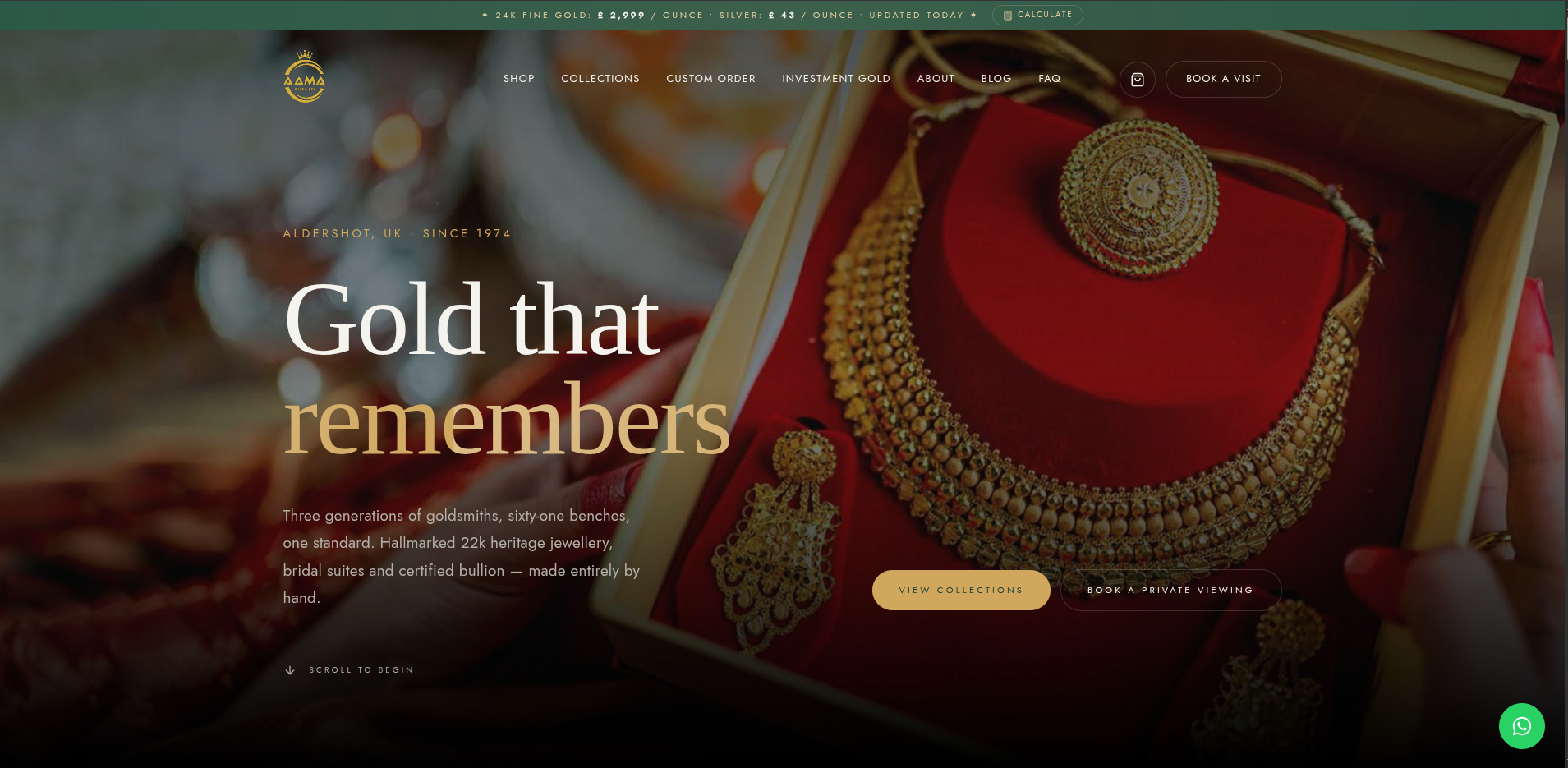
Aama Jewellers
A modern storefront replacing an outdated site, with a shorter checkout and social campaigns feeding it — built and handed over as one piece of work rather than two suppliers pointing at each other.
View Case StudyFrequently Asked Questions
What is a custom CRM and how is it different from Salesforce or HubSpot?
Salesforce, HubSpot and Zoho are products built for a general market and then configured to your business. A custom CRM is an application built for your business from the start. Products are faster and cheaper to begin with and carry mature features you would never build yourself. Custom fits exactly and has no per-seat licence, but costs more upfront.
How much does it cost to develop a CRM in the UK?
Scope drives it, not seat count. What moves the figure is how many pipelines you run and how complex each one is, how many systems it must integrate with and whether those have usable APIs, how clean your existing data is, how much quoting logic is genuinely bespoke, and whether field teams need mobile access.
How long does it take to build a custom CRM?
A focused system is typically eight to twelve weeks from scoping to go-live. A full business CRM is usually four to six months. Complex platforms run longer. Data migration and your team's availability for testing are the two things that most often move the date, and both are worth planning for honestly at the start.
Should I build a CRM or buy one?
Buy one if your process is standard, you need it soon, your team is small, or the scope is too thin for bespoke to be worth having. Build one if your team has abandoned the CRM you paid for, if licence costs across a growing team are significant, or if the value is joining it to systems you run.
Can you migrate our existing CRM data?
Yes — from another CRM, from spreadsheets, from an old database, or from a combination. We clean, de-duplicate and map the data, import it into a staging environment, and give you a reconciliation report to check before anything goes live. Messy source data is normal and we plan for it rather than being surprised by it.
Who owns the CRM and the data once it is built?
You do: the source code, the database and the designs, on final payment, with the repository transferred to an account in your name. Your data is exportable throughout, not only at the end. If you move to another developer we hand over the schema, the pipeline configuration and the migration scripts, and help with the transfer.
Can it integrate with Xero, Sage, Outlook or our phone system?
Usually yes. Xero, Sage and QuickBooks have workable APIs, as do Microsoft 365 and Google Workspace. Telephony varies by provider. Older or industry-specific systems are the ones to check early: some have proper APIs, some a database we can read, some neither. We check at scoping rather than discovering it in month three.
What happens if we need changes after launch?
Expected, and planned for. The first three months after go-live always surface things nobody anticipated. We work either on a support retainer or at a day rate, whichever suits how much change you expect. The system is yours, so you can also take it to another developer or bring it in-house.
Which industries have you built systems for?
We have delivered software and web systems across healthcare, retail and jewellery, renewable energy, agriculture and professional business services. We have not built a CRM for every sector, and if yours is one we have not worked in we will say so — what matters more is whether we understand your process, which is what the discovery workshop is for.
Let's Build Something That Matters.
Tell us what you're trying to achieve and we'll help you find the right solution.